
Blog
What are the steps for implementing CBT? We'll also explain the selection criteria for the operating company and the process of creating the exam.
- CBT
CBT(Computer Based Testing)is a general term for Test Format conducted using computers, and the test center (Test Center) method is one of the most common implementations. Compared to PBT (Paper Based Testing), which is conducted using paper materials, the design and operation of the examination are significantly different, so many examination organizers are unsure where to begin.
This article explains the reasons for the increasing adoption of CBT (Computer-Based Testing), the procedures for implementing CBT, key points for selecting an operating company, and the process of creating an exam.
Reasons why CBT adoption is progressing
The reasons for the increasing adoption of computer-based testing (CBT) include improved convenience for Candidate and increased efficiency due to the digitalization of operations. Let's take a closer look at the specific reasons why CBT is being adopted.
< Main background of CBT adoption >
- Easy to accommodate Candidate 's schedule.
- Digitalization can improve efficiency.
- This leads to a reduction in the risk of information leaks and fraud.
- Capable of handling a wide variety of questions.
- It is easier to consider flexible operation during infectious disease outbreaks or natural disasters.
Easy to accommodate Candidate 's schedule.
Computer-based testing (CBT) is gaining traction because it allows for easier scheduling of test dates and Test Center to suit Candidate' convenience. However, modern lifestyles are diverse, and gathering large numbers of people in the same Test Center at a specific time could lead to missed Candidate.
Digitalization can improve efficiency.
Because CBT (Computer-Based Testing) handles everything from question creation and answer recording to scoring and tabulation using data, the efficiency gained through digitalization is another reason for its increasing adoption.
With the increasing digitalization of administrative procedures and business operations, exam administration that relies on paper printing, delivery, and storage is likely to be subject to review from both a cost and risk perspective.
In particular, examining the costs associated with processes that rely on people and paper, such as processing exam applications, assigning Test Center, and preparing materials for distribution on the day of the exam, makes it easier to identify areas where efficiency can be improved through computer-based testing (CBT).
This leads to a reduction in the risk of information leaks and fraud.
In paper-based testing (PBT), human intervention is involved in processes such as printing, distributing, and collecting question and answer sheets, which can create information management risks depending on the management system. For example, the risk of information leakage increases depending on how question sheets are handled and stored, and the possibility of answer sheets being lost or mixed up cannot be ruled out. Furthermore, even at Test Center, it may be difficult to completely prevent cheating depending on the operational conditions.
On the other hand, with CBT (Computer-Based Testing), it is possible to centrally manage everything from question creation to answer recording and scoring within the system.
Since the transmission and reception of data related to the exam can be encrypted, the risk of information leakage can be expected to be reduced. By adopting a system that allows the question structure and order to be changed for each Candidate, it will also help prevent cheating such as sharing of exam content.
Capable of handling a wide variety of questions.
One reason for the increasing adoption of CBT (Computer-Based Testing) is that it allows for a wider variety of questions, including those using images and audio that are difficult to express on paper, as well as questions about how to operate equipment. For example, with voice input, evaluations of speaking tests and other assessments can be conducted fairly and efficiently.

It is easier to consider flexible operation during infectious disease outbreaks or natural disasters.
With Test Center-based testing (CBT), which uses a distributed testing system, it becomes easier to consider distributing the testing Test Center and dates, especially when it is necessary to avoid large crowds, such as during infectious disease outbreaks. Adopting a test center system also makes it easier for Candidate to choose Test Center close to their residence, reducing the burden of long-distance travel.
Furthermore, in the event of a disaster in a certain area, CBT (Computer-Based Testing) makes it easier to consider alternative Test Center or schedule changes, depending on the exam regulations and operational conditions. Since the possibility of last-minute Test Center changes or cancellations varies from exam to exam, it is important to check the operational conditions in advance.
Steps for implementing CBT
The steps for implementing a computer-based testing (CBT) system can be broadly divided into three stages: "requirements definition," "selection of an operating company," and "start of operation." Let's take a closer look at the specific steps for CBT implementation that test organizers should keep in mind.
1 Requirements definition
First, articulate the purpose of introducing CBT, and define requirements such as the scale of the exam, frequency of implementation, method of notifying results, and inquiry system. If transitioning from PBT, it is advisable to create a role-sharing chart outlining who will primarily handle tasks such as application, result announcement, and initial responses to inquiries. In addition, including measures against cheating and countermeasures for network failures in the initial requirements will help reduce rework during the process.
When defining requirements, quantifying each one as a KPI (Key Performance Indicator) makes it easier to prioritize improvements.
Furthermore, when considering in-house development of a CBT system, it is necessary to make decisions that include the possibility of a longer development period and increased maintenance costs. If the entire process, including test administration, is handled in-house, it will also incur the burden of quality control and system building.
2. Selection of the operating company
When selecting a CBT (Computer-Based Testing) operating company, compare multiple companies based on factors such as the number and geographical scope of test centers, security, international support capabilities, and management panel functionality. Make your decision after verifying their track record and operational quality. It's crucial to define your selection criteria before outsourcing to an operating company.
Outsourcing CBT (Computer-Based Testing) allows for a quicker implementation of the process, including Test Center management and Candidate support. However, if the scope of the contract and the boundaries of any additional costs are not clearly defined, unexpected expenses may arise.
When comparing quotes, it's important to check not only the initial costs but also the operating costs and additional support fees. It's also reassuring to clarify roles, responsibilities, and who will handle problems before signing a contract.
3 Start of operation
Once the operating company is decided, the CBT operation will begin. After the questions are submitted, the system will be configured and the page for Candidate will be published. Conducting a small-scale trial before registration opens to identify weaknesses in the inquiry flow and troubleshooting procedures will help minimize confusion on the day of the test.
Furthermore, after implementation, it is important to regularly review the exam data and continuously improve the balance between exam quality and operational burden.
Key points when selecting a CBT (Computer-Based Testing) operating company
When selecting an operating company, it's crucial to evaluate not only the unit price but also the operational burden that may arise after the contract is signed. Here, we'll introduce key selection points focusing on three aspects: cost, service scope, and troubleshooting.
We will track costs item by item and make decisions based on medium- to long-term ROI.

Check the services that the operating company can provide, along with the contract terms.
When selecting an operating company, it's reassuring to not only look at whether they "can handle" your needs, but also to understand exactly what is included in the contract. The following seven points are important to check when evaluating service details.
| Checklist | Checklist |
|---|---|
| Number of Test Center | Are there enough Test Center and seats? |
| Test Center quality | Are the reception and exam proctoring staff, PC specifications, and noise reduction measures of high quality? |
| Scope of services provided by the agency | Are you able to handle applications, administering exams, notifying results, analyzing results, and assisting with exam creation? |
| Security | Can you check the data management status and the status of certifications such as ISO 9001 (quality) and ISO/IEC 27001 (information security)? |
| Overseas expansion / Weekend support | Can they accommodate overseas exams and weekend sessions? |
| Test results | Do they have experience in testing highly rigorous areas? |
| cost | Are there any conditions under which additional costs may be incurred beyond what is included in the estimate? |
Regarding contract terms, confirming responsibilities and cost allocation in case of trouble, whether subcontracting is involved, information management, and termination conditions will help minimize misunderstandings after implementation. Coordinate with your company's legal department and IT department as needed.
Verify that the measures in place to prevent problems during the exam administration are comprehensive.
In exam administration, it is crucial to be prepared for various issues, such as terminal malfunctions, network failures, and doubts about identity verification on the day of the exam. Ensure that operational flows for each anticipated scenario are documented.
If you select an operating company without a clear understanding of the process, it may lead to delays in decision-making during problems and potentially spoil the exam experience.
Furthermore, if the inquiry channels are weak, inquiries may concentrate on the organizer's contact point, increasing the operational burden. It is important to comprehensively evaluate the operational system, including chat, telephone, email contact points, and a contact network for reporting problems.
Test creation and configuration process
The method for submitting exam questions and various settings vary depending on the system and division of responsibilities of the operating company. Here, we will introduce the general flow of exam creation and setup.
1. Organize the exam design and submit the exam questions.
First, you decide which question format to use, such as video, audio, or written questions. Next, you create the exam questions and submit them in the format specified by the administering company.
If the number of tests or the testing period is extended, take into account the increased exposure of the questions and increase the variety of question formats, such as expanding the question pool or introducing a random format where the questions change for each Candidate.
Furthermore, Prometric 's CBT (Computer-Based Testing) allows for the use of images, videos, and audio in the questions, and the test can be delivered in a standardized environment with standardized monitor size and resolution.
2. Preparation for implementation
To prepare for the exam, we will handle various system settings, convert the exam questions to computer-based testing (CBT), and create a dedicated exam webpage. Since the required tasks differ from those for paper-based testing (PBT), please contact the operating company whenever you have questions.
3. Release of a dedicated exam page for Candidate
We will publish a dedicated exam page for Candidate, containing an overview of the exam, event information, announcements, contact information, and more.
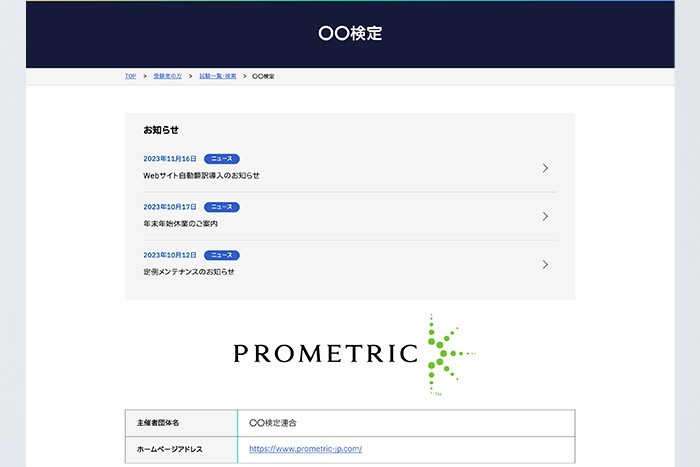
Since Candidate register for the exam through a dedicated exam page, they will also need to select a payment method. Available payment methods may vary depending on the exam, so be sure to prepare the information you need to provide to Candidate in advance. You can find information on payment methods for Prometric CBT exams on their official website.
*The screen image is for illustrative purposes only. Displayed items and other features may vary depending on the operating company's services.
Payment methods | For Candidate | CBT/IBT World-class test management | Prometric
4. Conduct the exam and announce the results.
If the test takes the exam at the date, time, and Test Center reserved by Candidate, and the passing criteria and notification procedures for results are predetermined, it may be possible to notify the test taker of the results immediately after the exam, depending on the exam specifications.
With Prometric 's CBT (Computer-Based Testing), Candidate can obtain their score reports from their personal page. Furthermore, the management system for organizing bodies allows for the acquisition of result data and management of Candidate. For detailed information on these features, please refer to the official documentation.
For more information about Prometric 's CBT, please see the article below.
Prometric provides support from the planning stage through the implementation and operational design of CBTs.
The success of CBT implementation depends not only on tool selection but also on the quality of requirements definition and operational design. It is important to compare operating companies in line with your company's exam objectives, test-taking scale, frequency, and Candidate support policies, and to make a decision based on both short-term costs and medium- to long-term ROI.
Prometric has a track record of administering approximately 2.5 million exams annually in Japan, with a cumulative total of over 40 million exams. In addition to its nationwide network of test centers, Test Center leverages its strengths—including standardized quality control, rigorous identity verification and proctoring systems, security measures, and an international network—to support the implementation and operation of computer-based testing (CBT) across a wide range of fields, including national exams, certification exams, and college entrance exams.
If you are an exam organizer considering implementing CBT, the necessary preparation period and organizational structure will vary depending on the scale of the exam and operational conditions. Whether you are transitioning from PBT to CBT, converting a new exam to CBT, or designing operations that include overseas testing and weekend testing, please consult with Prometric from the requirements definition stage.



Questions about introducing CBT, consultation on operation, fees, etc.
If you have any questions, please feel free to contact us.